12 Angry Men
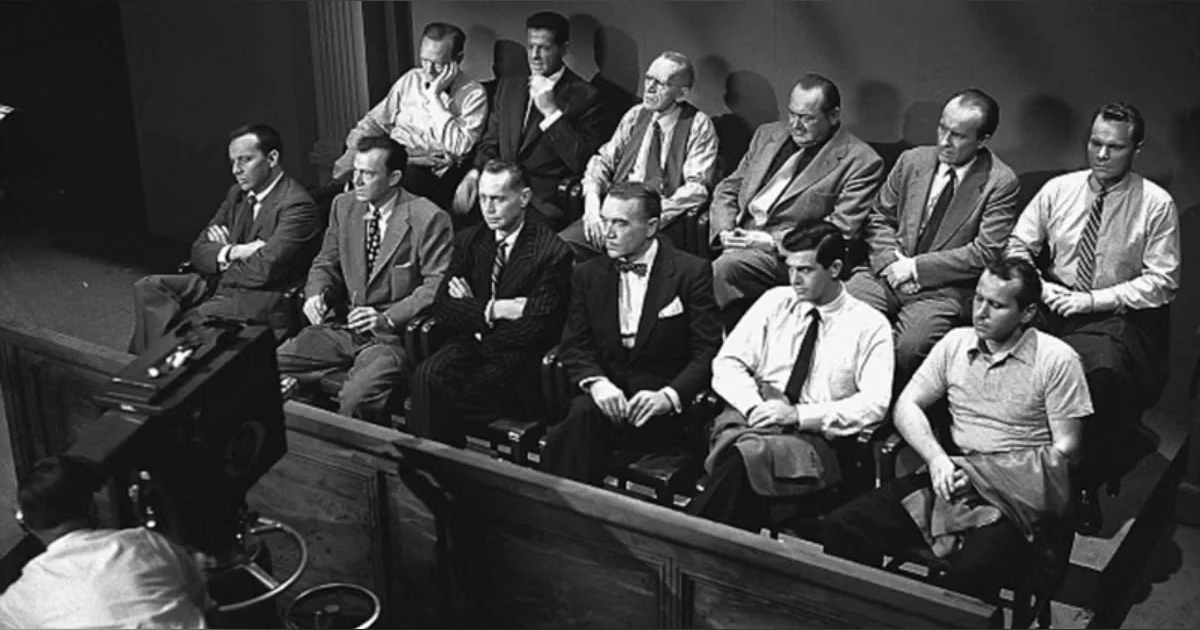
The Bad Dads gather for a compact but enthusiastic review of Sidney Lumet’s 12 Angry Men, a film that turns one hot jury room, twelve men and a supposedly open-and-shut murder case into one of cinema’s great arguments about reasonable doubt.
After the usual loose opening — Masters of the Universe chat, World Cup annoyance, and the rejected idea of everyone starting the episode by arguing — the dads settle into the 1957 Henry Fonda classic. Cris remembers watching it with his dad, Dan calls it an absolute classic, and Reegs immediately frames it as “an incredible piece of science fiction” because it imagines a world where people can be persuaded by rational thought and truth still matters.
The discussion follows the jury’s movement from an initial 11–1 guilty vote to the final reversal. Juror 8 does not claim the accused boy is innocent; he simply refuses to send him to death row without talking through the evidence properly. From there the dads work through the key doubts: the “unique” switchblade, the old man’s testimony, the passing train, the woman across the street, the boy’s shaky cinema alibi, and finally the glasses reveal that gives the film its big Sherlock-style moment.
They also dig into the characters around the table: the baseball-obsessed juror who just wants to leave, the ad man doing empty professional glad-handing, the logical stockbroker, the juror who grew up in the same kind of neighbourhood as the accused, the overtly racist juror whose rant causes the room to turn away from him, and Lee J. Cobb’s furious Juror 3, whose resentment toward his own son bleeds into his insistence that the boy must be guilty.

 YouTube
 Apple Podcasts
 Spotify
 Amazon Music
 Overcast
 Castro
 iHeartRadio
 PocketCasts
 Castbox
 Podchaser
 TuneIn
 Deezer
 RSS Feed
 This week on Bad Dads Film Review, we review Sidney Lumet’s 12 Angry Men, the 1957 jury-room classic starring Henry Fonda and Lee J. Cobb.
A young man’s life is on the line. Eleven jurors are ready to convict. One juror wants to talk. From that simple setup, the film becomes a tense, brilliantly engineered argument about reasonable doubt, prejudice, memory, class, personal baggage and the terrifying confidence of people who think they are definitely right.
What we covered
- The beautifully simple setup: a death-penalty murder case, a hot jury room, and a judge who seems very ready to go home.
- Juror 8’s position: not “he is innocent,” but “I am not convinced beyond reasonable doubt.”
- The first 11–1 guilty vote and how quickly the accused boy could have been sent to death row.
- The supposedly unique switchblade, and the moment Henry Fonda produces an identical knife.
- The old man’s testimony, the timing experiment, the passing train, and whether the witnesses could really have seen or heard what they claimed.
- The boy’s cinema alibi, and why forgetting details under stress might not prove guilt.
- The glasses clue and the late “Sherlock” moment that shakes the logical stockbroker juror.
- Juror 10’s racist rant and the powerful staging of the rest of the room turning away from him.
- Lee J. Cobb’s Juror 3, whose anger toward his own son becomes tangled up with the fate of the defendant.
- Sidney Lumet’s craft: the rehearsals, the sweat, the lowering camera, the tightening room, and the way the film becomes more claustrophobic as it goes.
- Why the premise can be remade in different countries and eras as a way to examine each culture’s justice system and prejudices.
- Whether some of the jury-room behaviour would cause a mistrial in real life. Short answer: probably yes, especially the duplicate murder weapon.
Key quotes / moments
- Reegs calls it “an incredible piece of science fiction” because it imagines people being persuaded by rational thought.
- Sidey points out that the film never proves innocence; it proves doubt.
- Cris remembers watching the Henry Fonda version with his dad.
- Dan compares its single-room effectiveness to the pleasure of low-budget, high-idea films like Coherence.
- The dads admire how every line either reveals character, advances the plot, or exposes someone’s bias.
- Dan lands the final group verdict: this is “four agreed men.”
Verdict
A unanimous and very strong recommend. The dads see 12 Angry Men as one of the strongest black-and-white films covered on the podcast: precise, gripping, brilliantly performed and still painfully relevant.
We love to hear from our listeners! By which I mean we tolerate it. If it hasn't been completely destroyed yet you can usually find us on twitter @dads_film, on Facebook Bad Dads Film Review, on email at baddadsjsy@gmail.com or on our website baddadsfilm.com.
Until next time, we remain...
Bad Dads
12 Angry Men
Sidey: [00:00:00] Is there an intro?
Reegs: No
Sidey: Just going for it? Yeah. I- There should be an intro ... I wa- I started watching, 'cause I know we're not doing a full episode, but I did start watching Masters of the Universe.
Reegs: the Universe. Oh, right. How's that?
Sidey: Really camp. Okay. I haven't got... Well, I've got to Skeletor and stuff. Yeah. But it's really long.
It's two and a half hours long, so I've got- It's excessive ... quite a lot left. Yeah, really excessive. There's loads of fisting gags, which seems strange. And
Dam: that seems, yeah, a bit inappropriate.
Sidey: yeah. So that's what I've been doing. Okay. Mm.
Reegs: Just
Dam: yeah. So that's what I've been doing. Okay. I just thought we should all come out arguing then, and there would've been, like, four
Reegs: won't do that.
Dam: Oh, right. Well, don't bother then. But I think that would've been a better start. What'd you think, Chris?
Reegs: I,
Cris: I was gonna argue with you because you thought you knew what I was gonna say, and- Yeah.
Well, I- ... it was completely wrong. All right.
Dam: Well- You... Well, what, what were you gonna say?
Cris: the fact that you write all the intros, it's not really all about you, Riggs.
Dam: Oh. So. What were you gonna say? 'Cause I, I wasn't interested
Cris: say that I did watch this film, [00:01:00] obviously. Mm.
And I was ... I'm pretty convinced I watched it before. Right. However, I don't really remember all of it, but I do remember bits of it, so I wasn't gonna say that I think someone or someone might not be guilty. All right. I think it was.
Sidey: he was.
Reegs: was.
Cris: it was more the fact that ... It was more the fact that I've definitely seen this film before.
Reegs: Yeah. They've done it
Dam: before in 1997 as well as this 1950s version.
Reegs: Yep.
Cris: no, this one. The, the, the- Yeah ... Henry Fonda one. I've definitely seen this one before. And I've definitely watched it with my dad.
Sidey: is 12 Angry Men. It is. Yeah. Yeah,
but
Dam: we're four angry men.
Cris: I'm angry with someone, but I'll get over it.
Four myth idiots. In, in the- Yeah. More, more accurate That's probably right.
Sidey: angry. I'm a bit angry that Brazil won, but I'll get over it.
Reegs: Four miffed idiots. In
Dam: Yeah. Yeah. Four, four myths. More accurate. That's probably right. Yeah, there has been a lot of World Cup content going on in, in my world recently more than movies, but this is an absolute classic. And- Well,
Sidey: you know, widely acknowledged sort of classic fare, this, isn't it? Yeah. An
Reegs: incredible piece of science fiction, I think, t- taking place as it does in an alternate universe where [00:02:00] people can be persuaded of things through rational thought, and things like truth and justice matter. Well,
Dam: it's black and white world. Yeah. Yeah.
Sidey: I don't think much of the lawyers in this, though. What must have happened? Anyway, 'cause we join it at the end, right?
Cris: end, right?
Reegs: Yeah the
Dam: Yeah And
Sidey: judge is basically telling them to fuck off, and I guess he didn't have women on juries- No ... at this point.
Dam: no.
Sidey: In the '50s.
Cris: Why would you?
to
Reegs: to make
Dam: such big decisions. But yeah, we, we've... The trial has been- We
Reegs: don't even see the closing arguments. No. We just hear- The trial has been-
the judge, and
Sidey: looking a bit bored, and
Reegs: Hot and bored- Yeah ... and
Dam: hot. It's, it's a hot city. It's a heat wave, much like we've just had actually.
Sidey: and are gonna have again.
And
Dam: these guys have all got better places to be. None of them really wanna be there.
Reegs: But he tells them-
Dam: a very much open and closed case of murder.
Sidey: It says this is, is the death sentence as well.
Reegs: He says it's a death sentence, and you, you cannot have a hung jury. You know, this has gotta be a unanimous decision.
Dam: or nothing. Yeah.
Sidey: you're in that fucking hot room till you figure it out. Yeah.
Reegs: And we briefly get a shot [00:03:00] of who we're talking about, the, the, the boy at whose fate we are to decide.
Messer Dozel. Messer Erzel. Yeah.
Cris: Kinda has that face, doesn't he? Pre-Hench. Yeah.
Reegs: Yeah. Yeah. A young, pretty young-looking-
Sidey: He's just gonna...
Yeah
Reegs: Mexican or Puerto Rican- Yeah ... or something
Dam: Hispanic kind of 18-year-old that's been accused of killing his father. And,
Reegs: is one of the only shots that takes place outside of the little room- Yeah
over the
Sidey: That's it
Dam: That's it ... the runtime. So that-
Reegs: ti- That's it ... over the runtime. Yeah. So they end up filing into this little room, which will be the space for the movie.
Cris: and they get locked
Dam: anybody that's been on jury duty before will know... No, I've never been, but they will know that- You're you're in a hot sweaty room and you can't leave.
But no, they do keep it all very much- Yeah ... boxed in, don't they? And you, you're not allowed to get that influence from outside and all, all the
Sidey: You would have no phones nowadays and all that
Dam: this is back in the day. And although it's shot, it's beautifully shot in black and white, but you can feel the heat as well
Reegs: You [00:04:00] can. A- and it's emphasized through the characters sort of dabbing and mopping at their brows and opening windows. But it- You can see
Cris: sweat on them as well- Yeah ... like proper sweat.
Dam: All
Sidey: big sweat
Reegs: four, actually, who stays ice cool until the very end of the movie.
Dam: S- Sy-
Sidey: glasses and the suit on?
Dam: Sidney Lumet, who did this film, he kept them all in there for hours just talking to each other, going over and over the
Reegs: rehearsed it for two weeks. Yeah. And then he shot it as the camera moved around. He didn't shoot it in order, he shot it from each of the characters' perspectives as the camera moved round- Right
which is a crazy thing to do. But yeah.
Sidey: there's one guy, I don't know, is he appointed to sort of be the head of the jurors or does he just
Reegs: number one, so you by default you become the
Sidey: just assume the role. Right. So
Reegs: So
Sidey: he sits them all down and they decide they're gonna sit in order.
And they do an initial vote and some people... Just not a secret ballot, but just a show of hands. Yeah. And there's probably like half a dozen straight away say guilty. And then there's a few tentative hands that just sort of follow. And then there's one dissenting
Dam: 11 of the 12
Sidey: it's 11 of the 12 that- It's
Dam: that [00:05:00] say guilty. And
Reegs: And so,
Dam: And
Sidey: mean, we're, we're like- ... juror number eight ... two minutes to decide that they're gonna send this guy off to death row. Yeah. And juror number-
Dam: Eight
Sidey: Eight ... eight says, "Well, I think we should talk about it." Yeah. At least Go through it a bit
Reegs: guy, juror number seven, has already made a glib comment about trying to get to the ball game later.
And it's clear from the off that some of these guys are not treating this very seriously. Juror number 12 is an ad executive who just seems to be there- Do nothing ... to like glad hand people and kind of-
Cris: Yeah, the guy tries to give them the card. It's like, "Oh, this is what I'm doing," and he, he kinda takes
Sidey: can't pick it up- He, he draws a pack of cereal or something, doesn't he? Yeah.
Yeah.
Cris: and then the other guy is like, "Oh, okay, mate." Then he puts the card back in his-
Dam: Well,
a- again, if you, like, had any experience with jury duty, then it's something... No, but I have, I've
Reegs: have,
Dam: the- None at all. Absolutely nothing. But if you have, you might also agree with me that you get the letter through, 'cause I've seen it friends and family have, have been called up, and you, you're expected to go.[00:06:00]
Like, you know- Yeah ... you can't get out
Sidey: of,
going. Yeah, you need a good excuse
Dam: You need a, a good excuse to go,
Reegs: like,
Dam: you know,
that you're, you're caring for your family or-
Cris: Or a plane
Dam: or something ... or that, you know, there, there's- Yeah ... there's something. So these guys have all been called up with better places to be and, and more important places to be in their minds.
And they want out. So juror number eight says, "Look, okay. If everybody, if every... We'll go anonymous this time, though. But if every... Let... Hear me out, and if everybody agrees with me-"
Sidey: Well, he ma- he ma- he makes some points before they-
Reegs: does. He get... Because I
Sidey: guy ends up-
Reegs: they're like, "You think he's innocent?" He's like, "No, I'm just not convinced beyond reasonable doubt," which is the
Sidey: gonna kill this guy
Reegs: been- Yeah
determined. And death, you know, it's in his, life is in his hands. And I think there is a quick break quite early on where they go to the bathroom. It's the only other scene that's, Yeah ... in there, because one of the other jurors- The old man ... will challenge him and say, "What if he is guilty and you're sticking up for him as being innocent?"
So he's got that to weigh on his- Yeah ... conscience as well. And what it is a thing to stand up in front of everybody [00:07:00] else-
Dam: When everybody
Reegs: everybody's saying guilty to say not, I think not
Dam: but it is a, it's a good call. He wants to be sure that beyond reasonable doubt. Yeah. So- Yeah ... he sets out a couple of these arguments and then they have an anonymous vote.
Reegs: Well,
the anonymous vote I think is after the, they start talking about, he wants to start talking about the specifics of the case, and one of the things is the uniqueness or otherwise of the murder weapon- Mm ... which is a switchblade.
Yeah. Yeah. And there, it's the first of, like, several facts that will be demolished that everybody else has just taken for granted. Juror number four, he's a, he's a stockbroker and a rationalist. I think he's probably the most logical of all of the people there, so he's the one who will get involved in all of these conversations quite a lot.
So yeah, they're all convinced about the uniqueness of this blade, that the they've said that the, the prosecution has said is a one of a kind, and then juror number eight pulls one out of his pocket and is like- Yeah ... "I went wandering down the streets, and this is where you can just go and get these."
Sidey: just go and get these."
$6 it
Reegs: $6, yeah. [00:08:00] So it's the first time that people start to be shaken, and when they do a vote after that, somebody else has joined him.
Dam: It's juror number nine.
Sidey: Yeah. There's an... Was it nine, was it? Yes.
Reegs: It's the old man.
Sidey: Yeah, the old man, and, and then there's another guy across the table who's like, "I grew up amongst..."
'Cause then you start to get- Yes. Yeah, yeah, yeah ... you start to get a few comments about those people. Yeah. And you're like, "Oh, okay." Right.
Reegs: Well,
that's juror number 10 is really overtly racist. Yeah. The leader of the sort of guilty, the one who's most convinced, is
Sidey: it's jury- But there's one who's, one... But there's another one who's grown up with him, and he's not
Reegs: Lee Cobb. Yeah. Yeah.
Sidey: another one who's grown up with him, but, and he's not racist. He's like-
Reegs: He's number five
Sidey: one that votes no next, isn't he? Yeah. Yeah. Yeah.
Reegs: So you, you get a few... You start to get their characters. And th- they basically sort of split into camps. Three parts. So you've got Lee Cobb as, as juror number three.
He s- who lets slip quite early on that he's had a, a sort of an estrangement from his son. Yeah. He said something about like he, he wasn't much of a fighter, and they got into a fight, and his son punched him, and he hasn't seen him for three years or whatever. Yeah. And then juror number five, you start to find out [00:09:00] he's actually from the kind of slummy area where this comes from, and has some sympathy maybe more to- Yeah
the community, and awareness of what's going on. So-
Dam: Just,
Sidey: to know the, the things that the case hinges on- Yeah ... is that they've heard a fight.
They've heard someone say- They've heard someone say, "I'll s-
Reegs: I'll kill you." "I'll kill you." And he eventually goads juror number three into saying, "I'll kill you," in the cour-
Sidey: Then they hear a body hit the deck, and then an eyewitness has seen him from across- Yeah ... in through a train window- Yeah
Has been able to positively ID, so they say.
Reegs: And an old man has been IDing him three hours later, retrieving the murder
Sidey: And he said that he, his mu- his alibi was that he'd been at the movie theater. Cinema, yeah. But he couldn't remember, 'cause they nail one of them on that- Yeah ... on what film he'd been to see.
He couldn't remember what- Yeah,
Reegs: or who the characters- Yeah, yeah ... the stars were of that film, yeah.
Sidey: And so it's about- Figuring out are these things as plausible as it was sort of made out. [00:10:00] And he's straight away says, "I don't think that the defense attorney really gave a shit." You know? Yeah.
Didn't really fight this guy's case very much. So they kinda go through all these points and just trying to see if they're valid or not.
Reegs: They perform a s- a couple of different experiments and that sort of thing to, like, prove how long it would take- Yeah ... for the old man to get... You know, and they discuss his physical condition.
He had a club foot, I think, and he was dragging it, so how long would it take him to walk 43 feet? Would it be the 15 seconds he said? Yeah. And also the angle of the murder weapon, how you hold a switchblade, whether it would be down or up, like-
Cris: the angle is down, right? Yeah. Yeah.
Sidey: But then the other guy says that's not how you would...
You hold it like that. You open it and you,
Dam: You'd have
Sidey: Takes too long to open it, change it, do that. You just open
Dam: some kind of- This
Sidey: wouldn't have gone down
Dam: to do it that way. It's, it's like if it's- I've
Sidey: seen people fight with those, and that's not how you do it.
So slowly they start
Dam: demolishing or put at least calling
Sidey: into doubt some of these things- Is it putting enough doubt about each
Reegs: established, even though, like, you know... And everybody is, to an extent, getting drawn in. [00:11:00] Juror number seven, the baseball guy, is not really. He just really wants this thing over and done with.
Sidey: He's just- ... yeah, he's just like a fucking idiot.
Dam: other people
Sidey: have their motivations. You know, juror number one wants to keep everything going. Juror number two is the timid bank clerk.
Dam: He'll
Sidey: come up with a, an important point
Reegs: He's just,
Dam: observed right
Sidey: towards the end, I think. Yeah.
Reegs: yeah,
Cris: the one with the specs? Yeah. Yeah. Yeah. Yeah.
Reegs: He's just like, "Fuck it." Yeah, yeah ... juror number four is the logical guy. Juror number five we know. I can't remember, juror number six was the guy who challenges him in the restaurant. We get all the way through it until there's a big, essentially racist outpouring from juror number 10- Yeah ... which, you
know,
is supposed to be at the heart of some of this.
He's just like, "Oh, you know what those people are like." It's never
Sidey: like losing steam in his own argument- Yeah ... at one point when he's just like, basically just outing himself as a huge bigot. Yeah. And then he's, he's obviously like, "Oh God, what do I sound like?"
Dam: And then-
Reegs: And you get this incredible shot of everybody moving
Sidey: They just, yeah, they all just turn their back on him, and just let him
Reegs: they let him rant, and then they're like, "That's enough from you." And also Lumet [00:12:00] does this thing where the camera starts really high during the movie and stays really high, but during the movie gets lower and lower and lower and closer into the actors.
So by the end, it's like there in your face as we get to the resolution of it, which is really cool. And so after having demolished all these arguments
the
Sidey: they get the, get the, they get the banker guy or the stockbroker guy on the film thing.
Reegs: He's the final one, and his position is just cold logic.
He's like- Yeah,
sure,
Sidey: I
Reegs: You
Sidey: c- I'm not wearing a tie at all." Yeah,
Reegs: is a bit like that. Yeah. H- her testimony about her glasses, he's shaken. He starts to sweat when he realizes that- Yeah ... the alibi about not remembering the movie could be plausible- Yeah ... 'cause he couldn't remember the movie
Sidey: saw. He get, he mis-he
Cris: Yeah, and it was, it was four days ago or something like that. He went with the missus and he's like the second one, "Well, it was someone that I didn't really know." The first one he can tell straight away
Sidey: "It was the brilliant Mr.
So and So." The guy's like, "I saw that film. It was the magnificent Mr. Someone." Yeah. He's like, "Oh, fuck." Oh, fuck. Yeah.
Reegs: And then the second
bit
Dam: then it's a real Sherlock bit, isn't it? It's a real kind of where he, he just takes his glasses off and [00:13:00] he just kind of rubs hi- the, his nose where-
Sidey: old man, isn't it?
Dam: And he, he re- he realizes then that's what the woman did in the in the, in the trial. The old woman over who, who'd been the witness, and he realized, well, she must wear glasses. That's why she's done that, but she didn't wear them into court. Yeah. And- And
Sidey: and her thing is that she had heard a noise, got out of bed.
Yeah. And they're like, "Well, you didn't get out of bed- Put your glasses on ... put your glasses on and then go, oh,
Dam: the morning and then-
Reegs: then- So how convinced
Cris: Through the windows of a train.
Reegs: a passing train, yeah.
Dam: It's a lot to, to put a man's life on
Reegs: And that takes the... Now, at this point, it actually switches it, so it's 11 to one the other way around- Yeah
where Lee Cobb now is the only man clinging onto the guilty verdict.
Cris: that's when he b- he tears the,
the
Sidey: yeah, first of all, he's just so belligerent. He doesn't wanna be, like lose face and say, "Yeah, I was wrong or, or I could be wrong." He's just so-
Cris: Yeah. Yeah
he
Sidey: his way till he sees the picture of his lad and he just, he
loses it Yeah,
Dam: this lad isn't your
Cris: [00:14:00] kids, rotten children or whatever.
Reegs: and he's essentially holding this child guilty of this crime on behalf of his own son- Yeah ... who's wronged him. And he's got a deep resentment of the youth, so- Yeah ... he will eventually also come round to the correct decision,
Dam: yeah. And, and that's it. It was just
the,
Reegs: the
Dam: number eight who had questioned it and, you know, put
the,
the thought of are we 100% sure this back out to these other 11. And
Sidey: they
Reegs: did the ... I mean, everybody else would've literally just walked in there and gone, "Guilty. Yeah,
Sidey: Oh, like two minutes in they would've just- Yeah ... the guy would've been sent to death row. I
Reegs: mean,
And
Sidey: and important- And they just- ... they don't actually prove... There's no like, "Yeah, this guy's innocent." They're just like, "No, there's
Cris: doubt." Reasonable
Dam: doubt
Sidey: brought down ... we can't 100% say that this kid killed his dad.
We just can't say that." Yeah. So you cannot have someone killed for that.
Reegs: that. I don't think we see the verdict being returned, do we?
We just actually see them leave the courthouse one by one, and then the two jurors, eight and [00:15:00] nine, just exchange names on the steps. So he says- Yeah ... "Oh, what's your name? Davis." Davis. And McCardle, I think he says the other
Dam: Two, two kind of reasonable jurors out of it all.
And they-
Reegs: I couldn't have been more fond of this.
Sidey: Yeah.
Dam: Oh.
Well,
it, it, is an absolute classic. I mean, I've, I've watched
Sidey: Oh, I'm trying to get another one.
Cris: try the other one
Sidey: put this one in the Edward bins.
Dam: Yeah, I've, I've watched this at least three times over the years. It's an absolute, you know, Stonewall classic of, of the genre. I mean, it was Oscar nominated I think three times, but also importantly, I think it's been shown even in in US history.
'Cause there's one long speech where they talk about the the US justice system- Mm ... being one of real honor and, you know, one of, of great care and fairness and justice- ... and all those kind of things.
Cris: If you make it to court. If,
Dam: if, if, if you can, you
know...
And, but still, you know, that [00:16:00] is the ideals, and I think that there was one- It's contentious
there was one great- At times ... yeah, one great kind of court justice now who's, who says to a jurors, "Watch this," like, you know, before you start deliberating too much and just going straight towards a-
Reegs: Yeah. There's several things that you c- they did in this though that would've caused a mistrial if they'd done it
Dam: Yeah, I mean, this, this isn't
like,
Sidey: The
Reegs: pu- get- producing a duplicate murder weapon in the, Yeah ... room is a, is a big no-no.
Dam: Yeah. Bringing a, bringing a weapon- Yeah ... into the juror room is probably i- is wrong. But there i- there's obviously a lot around the, the understanding of deliberation and, and being given a fair trial.
Reegs: It's more about- ... certainly when it's- ... everybody's representing an idea, aren't they really? And it's like systematically explained to you and then knocked down each time. Like-
well,
Dam: but they, they... you need to be open enough to be able to talk about it, and not bigoted enough to just stick to your position, which obviously he was right to the end because you... he's realizing he's carrying [00:17:00] his own, you know, filters through this, his own preconceived ideas of what happened because of the things that has happened in his life- Yeah
not the facts of the case. Yeah. And they've had to y- you know, between them pick at it. They've all got little bits of information like, you know, the, the juror who's guessed the glasses, he wore glasses, so he knows he's done that and he puts that together and it's, it's another big piece of the jigsaw that helps con- further convince other members of the, the jury.
It, it's shot in a month in one room, you know, this film. It's, it's not one of tho-...
Reegs: 21 days, wasn't it? The other,
Dam: The other kind of thing that I, I love about these films, like, we watched Coherence back for the pod few... probably a couple of years ago now, wasn't it?
Sidey: Good few years, yeah
Dam: and it has that same kind of, you know- brilliance that you can put a fantastic film together without a huge set, without going out and, you know, it's around the idea, and [00:18:00] it's around the, the conversations
Cris: also the performance because it's really difficult to keep things going.
Sidey: And, and
Cris: don't get me wrong, I had a probably about a 10-minute period when I fell asleep at this film.
Dam: 10? But... Yeah. Yeah.
Cris: But generally I was, I was fairly focused on it, and
Sidey: there's
Cris: few films that are, like you say, filmed in
Dam: one room- It's an old film as well, yeah
Cris: especially for a, for a black and white film- Yeah
to just be, still be able to, to be curious and be kinda there and, and not grab your phone or not go for a cup of tea or whatever. Yeah, yeah. So to, to have that. And everyone kinda had their part, even the ones that... 'Cause there's a couple of them that don't really say that much. Yeah. But when they do, they do make a difference- Yeah
or they do shift the opinion
Reegs: Everybody- To a half of
Cris: them in the room,
Dam: Yeah.
Reegs: there's, like, a just a brilliant economy of everything in this. Like, every line furthers the story in terms of their character or their belief system or- Yeah ... or the plot.
Or where they're from or ... Yeah. Or like, it's so tight, and [00:19:00] then, you know, so it's just a g- and great ensemble and,
Sidey: directorial debut as well.
Reegs: Yeah. Do you think what's his name, Cobb, looks a bit like Jason Segel? Mixed with, ... Louis Mandylor that we did the,
Dam: was in, Yeah.
Reegs: thing
Sidey: thought he reminded me...
Cobb was number three?
Reegs: Yeah.
Dam: He's in loads
Sidey: me of,
Cris: Cobb. He reminded me of,
Reegs: reminded me of,
Sidey: he's the one with the- ... Rodney Dangerfield for some reason.
Reegs: Yeah.
Sidey: an angry Rodney Dangerfield.
Dam: is
a, a, a bit like Dangerfield, I reckon. But I mean, Cobb's been in tons of movies and things. Yeah. He's a really kinda big time actor, and obviously Henry Fonda,
Sidey: brilliant. His one and only film. Yeah. Yeah, amazing.
Cris: He definitely- Do we have any stats for this?
Sidey: It wasn't a huge box office smash.
Reegs: it was a floppy floppy,
Sidey: didn't, mm-hmm.
Dam: Critics liked it, and the Academy recognized it with nominations. I dunno what won the-
Sidey: in the US National Film Registry
Reegs: big thing about it is it started coming up against color.
That was its problem, and black and white was going out of fashion in 1957.
Sidey: I haven't seen the [00:20:00] remaking thing of it.
Reegs: No
Sidey: William Friedkin did a TV version of it.
Reegs: Yeah. And it's been multi- I think it's been multiple TV versions across all
Sidey: countries. I never understand that. I get, I get it if someone's had a great idea, and there's been a, an attempt at it, and it hasn't landed, then remake that.
But just show, just
Reegs: Ah, but this one you could set anywhere and just do a very personal exploration of your justice system- Yeah ... and your cultural things. Like, that's, that's what makes this so good, right? You could rewrite this now and it would be different, but it would be
Cris: good. The, the, yeah, the premise would be the same- Yeah
kinda thing. Like, someone's accused of doing this- Yeah ... whatever this is. And
Reegs: now let's examine our prejudices. Let's examine- Yeah, yeah, yeah ... all this
Dam: cultural kinda norms of the day and
Reegs: things, yeah
Cris: yeah Because it is true in, in the jur- in the, in the court, obviously for those who have been. Have you
Dam: been, Dan? Yeah. No, I've not
Cris: Okay.
Sidey: I've not, no. Okay.
Cris: but, but for those who have- Yeah ... th- there's all sorts from different walks of life. So you could be someone that works as a bin man, someone that works in [00:21:00] a restaurant. Yeah. You can be someone that works in a bank. You can be someone that's a lawyer. You can be someone that's
Reegs: a- Yeah
a,
Cris: a toff or whatever they're called.
Yeah. Yeah. You know, you, you went to private school. You didn't
Reegs: old. You can be young. You could even be a woman.
Cris: Ugh. Yeah. Really?
Reegs: That's what they've changed these days. Okay. Well,
Dam: it's all sorts these days. Yeah. Not
Cris: sure what to make of that, but there you go.
Sidey: Overall? Overall,
Dam: it is for me one of the best black and white films we've seen on the pod. And it's a strong recommend.
Reegs: Yeah, it's the strongest of strong recommends. Very good.
Cris: Yeah.
Sidey: Really strong. Recommending
Dam: th- this is four agreed men
Cris: what is it? Is it just under two hours?
Sidey: Oh, it's an hour and a half.
Reegs: 90 minutes about, I
Cris: yeah, I was gonna say one,
Reegs: It's really
Sidey: I can tell you that. Hang on. 98
Reegs: minutes? 94?
Sidey: I can't tell you that.
Cris: I can't see that. Oh
Sidey: But it did feel like it was, it was an hour and a half. Yep.
Reegs: Yeah. Yeah.
Cris: And it was on Prime, right? Yes. That's where
Sidey: Prime. You can watch it for nothing as long as you've got a Prime membership.
Yeah. Yeah. And I, I would recommend that you do.
Dam: Yeah. Do it now.
Cris: Do we [00:22:00] have anything lined up for next week, sorry?
Dam: No.
Cris: No? Okay. Do we know whose turn it is?
Sidey: Yours.
Cris: Yeah, okay. I'll have something tomorrow.
Dam: Wow. Right. We're holding to it. That's huge, huge news. That's huge news.
Sidey: bigger than that.
Cris: Well, I'm not gonna say tonight, because by the time I get home,
Sidey: I want to do it- Well- Well, no, tomorrow's- Tomorrow we'll just wait.
We'll
Dam: Speedy Gonzalez. Yeah
Sidey: that remains is to say Sidie signing out.
Dam: Dan's gone.
Reegs: R- Reags has left the building. Not over there. Reags
Dam: Reeve's still here
Cris: Right. So